From Smoke to Solutions: One Pharmacist's Climate Story
Written by Haley Yarborough
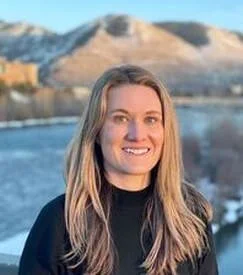
Hayley Blackburn vividly remembers the 160,000-acre Rice Ridge Fire in late July of 2017. She was driving from western Oregon after one of her favorite forest corridors caught fire, only to watch the smoke thicken and the sun grow redder as she got closer to her home in Seeley Lake, Montana. Blackburn's parents, both residents of the area, were forced to evacuate—despite her father's insistence that he could fight off the fire from the back of his tractor. She said her parents' reactions were somewhat "delusional," but understandable at the time. "These people that I knew growing up were dependent on the mill and tourism business for their livelihoods, and there's no tourism business because the town is on fire, and they have to stay and work in the mill," Blackburn said. "They have to, you know, breathe in the smoke all day because they have nowhere else to evacuate."
Blackburn, an associate professor of pharmacy at the University of Montana, said this moment helped fuel her desire to explore the intersection of health, pharmacy and climate—not just locally, but on an international scale. The following year, she worked with a planetary healthcare organization in Indonesia focused on rainforest conservation. Since then, she has collaborated on climate and health projects with pharmacies and universities around the world.
This past year, Blackburn spent nine weeks on sabbatical in Australia. The international collaboration began in 2021, when she partnered with a faculty member there on a virtual exchange program where students from different countries meet to discuss themselves, their cultures and current climate issues. During her time in Australia, Blackburn began to see striking parallels between Australia and the United States. "Australia and Montana are kind of mirror images of each other in terms of similar shared challenges with extreme heat and drought, and impacts on agriculture and wildfire," Blackburn said. Australia is the driest inhabited continent in the world, making it particularly vulnerable to drought and bushfires; challenges that increasingly mirror Montana's changing landscape.
Blackburn said she became interested not only in the environmental similarities between Australia and Montana, but also in how each place responds to those challenges. In general, she found Australia to be more climate-progressive in its policies, though she noted that experience may not reflect the entire country.
Blackburn's central focus now is addressing a niche area of climate action: pharmacy. "We interact with patients usually more than any other healthcare professional," Blackburn said. "...So for anything, whether it's smoky outside or there's a heat wave coming, patients are usually talking to the pharmacist first because the pharmacist conversation is free."
Blackburn believes nearly everyone has a climate story now. Hers began beneath smoke-filled skies over Seeley Lake, but it has since taken her from Montana to Australia, where she found many of the same questions echoing across continents: How do we protect people's health as the climate changes? Her answer starts close to home—with pharmacists, patients, and the everyday conversations that happen across the pharmacy counter.